
All-on-4 Dental Implants in San Antonio, TX: Cost, Benefits & FAQs
Replace missing teeth with the revolutionary All-on-4 technique. Minimal recovery, maximum stability.
Contents
What Are All-on-4 Dental Implants?
When patients ask me what All-on-4 dental implants are, I usually explain it in simple terms. It’s a treatment that allows us to replace an entire set of teeth using just four dental implants. These implants support a fixed full-arch prosthesis that looks, feels, and functions much like natural teeth.

What makes this technique different is how the implants are placed. Two implants are positioned at the front of the jaw, and two are placed at an angle toward the back. This approach helps us make better use of the available bone and, in many cases, avoid the need for bone grafting, which simplifies treatment for many patients.
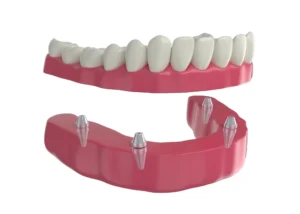
Unlike removable dentures, All-on-4 teeth are securely fixed in place. They don’t shift, slip, or need adhesives. For many people who have lost most or all of their teeth, this option offers a stable, long-term solution that restores both comfort and confidence.
Key Benefits of All-on-4 Implants
From a clinical point of view, one of the biggest advantages of All-on-4 dental implants is stability. Because the implants are anchored directly into the jawbone, the teeth stay firmly in place. Patients often tell me they feel more confident speaking, smiling, and eating without worrying about movement or discomfort.
Another important benefit is efficiency. With All-on-4, we can restore a full arch of teeth using fewer implants compared to traditional approaches. This usually means shorter treatment time, fewer surgical procedures, and a more predictable outcome—especially for patients who have experienced bone loss over the years.
All-on-4 implants also help preserve jawbone health. When teeth are missing, the bone can gradually shrink. Dental implants stimulate the bone in a way that dentures cannot, helping maintain facial structure and reducing the sunken appearance that often comes with tooth loss.
Finally, many patients appreciate the convenience of leaving the office with a functional smile much sooner. In suitable cases, temporary fixed teeth can be placed the same day, allowing you to return to daily life with greater comfort while your final restoration is prepared.
How All-on-4 Works
The All-on-4 process starts with a careful evaluation. We look at your overall oral health, review 3D scans of your jawbone, and discuss your goals and expectations. This planning stage is essential to ensure the implants are placed safely and predictably.
During the procedure, the four implants are placed into the jawbone—two straight in the front and two angled in the back. This angled placement improves stability and allows the implants to anchor firmly, even in areas where bone loss is common.
In many cases, a temporary fixed set of teeth can be placed the same day, which is why All-on-4 is often called “teeth in a day.” You leave with a functional smile while the implants heal and bond with the bone. After healing is complete, the temporary teeth are replaced with a final, custom-made restoration designed for strength, comfort, and a natural appearance.
All-on-4 Cost in San Antonio, TX
One of the first questions patients usually ask is about cost, and that’s completely understandable. The price of All-on-4 dental implants in San Antonio can vary depending on several clinical and personal factors. In general, treatment is priced per arch (upper or lower), and the total cost reflects the complexity of care, not just the implants themselves.
Several elements influence the final price, including the condition of your jawbone and gums, whether extractions are needed, the type of temporary and final prosthetic teeth used, and the technology involved in planning and surgery. Advanced imaging, guided surgery, and high-quality materials all play a role in achieving a predictable and long-lasting result.
While All-on-4 may seem like a significant investment, many patients find it more cost-effective over time than repeated repairs, relines, or replacements associated with removable dentures. It’s also important to remember that every case is unique. A proper in-person evaluation is the only way to receive an accurate estimate and understand which options make the most sense for your situation.
Who Is a Good Candidate?
In my experience, many patients who think they are not candidates for dental implants are often surprised to learn that All-on-4 may still be an option. This treatment was specifically designed for people who have lost most or all of their teeth, or whose remaining teeth are damaged, loose, or no longer predictable to maintain.
All-on-4 can be a good solution for patients who currently wear dentures and struggle with poor fit, movement, or discomfort. It’s also commonly recommended for individuals who have experienced some degree of bone loss, since the angled placement of the back implants helps maximize existing bone and may reduce the need for bone grafting.
That said, candidacy depends on several factors, including overall oral health, bone quality, and certain medical conditions. During a consultation, we carefully review your health history and imaging to ensure the treatment can be done safely and successfully. The goal is always to choose an option that provides long-term stability and comfort—not just a quick fix.
All-on-4 vs Other Implant Options
Patients often ask how All-on-4 compares to other full-mouth implant solutions. The main difference is the number of implants used and the overall complexity of treatment. With traditional full-arch implants, six to eight implants may be placed per arch, which can increase surgery time, cost, and the likelihood of needing bone grafting.
All-on-4 uses four strategically placed implants to support a full set of fixed teeth. This approach is designed to be efficient while still providing strong, reliable support. For many patients, it offers a balance between stability, treatment time, and overall investment.
Another option some patients consider is implant-supported dentures. These can improve retention compared to regular dentures, but they are often removable and may not offer the same level of comfort or chewing efficiency as a fixed All-on-4 restoration. When discussing options, I always focus on how each solution fits your lifestyle, expectations, and long-term oral health.
Pros and Cons of All-on-4
Like any dental treatment, All-on-4 dental implants have both advantages and limitations. In my conversations with patients, I always believe it’s important to be clear about both, so expectations are realistic from the start.
One of the main advantages is stability. Because the teeth are fixed to the implants, they feel secure and natural when speaking or eating. The treatment also uses fewer implants than other full-mouth solutions, which often means a shorter procedure, less recovery time, and lower overall complexity. For many patients, the ability to receive temporary teeth the same day is another major benefit.
On the other hand, there are considerations to keep in mind. All-on-4 is a surgical procedure, so healing time and post-operative care are important. While the technique works well for many people, it may not be ideal in every clinical situation, especially if there are certain medical conditions or severe bone limitations. Additionally, because the teeth are fixed, maintaining good oral hygiene and regular professional checkups is essential for long-term success.
When reviewing the pros and cons together, the goal is not to push one solution, but to help you understand whether All-on-4 fits your needs, health, and lifestyle. A personalized evaluation is always the best way to make that decision with confidence.
All-on-4 FAQs in San Antonio
How long do All-on-4 dental implants last?
With proper care, All-on-4 implants are designed to be a long-term solution. The implants themselves can last decades, and in many cases a lifetime. The prosthetic teeth may need maintenance or replacement over time due to normal wear, but regular checkups and good oral hygiene greatly extend their longevity.
Is the All-on-4 procedure painful?
Most patients are surprised by how manageable the procedure is. During treatment, anesthesia or sedation is used to keep you comfortable. After surgery, some swelling or soreness is normal, but it’s usually well controlled with medication and typically improves within a few days.
How do I care for All-on-4 implants after treatment?
Caring for All-on-4 implants is similar to caring for natural teeth. Daily brushing, flossing or using specialized cleaning tools, and routine dental visits are essential. Good maintenance helps protect both the implants and the surrounding gums, ensuring long-term success.